We look forward to learning with the following artists.
Click on images to find out more about them. |
| |
UNDERTAKE
The Practical Side of Death
November 2026 |
|
 |
|
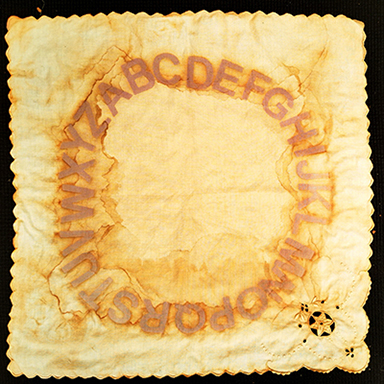
Alexis Williams, Ottawa
Director of the Biophilum
As an artist whose work is always expressing the value of life and living systems, the taboo against death as a conversation topic has not stopped Alexis from contemplating mortality in her performance, lab, wildlife photography and studio work.
Everyone can do it, but artists have a particular advantage as practiced creative players: we have a profound freedom to invent mourning rituals and regularly renegotiate our relationships with the dead, which Alexis celebrates and encourages in others. She is curently making sacred objects whose sole purpose is to reveal the magic in all mater, living or dead and the devine in every moment, banal or ceremonial.
|

Miriam Sagan, Santa Fe
Biophilium Research Mentor
I am a poet, not a naturalist, but my poetry often creates a “map” of a place, incorporating geography, geology, archeology, ecology, natural history, memory, and perception. I am interested in borders, what earthworks artist Robert Smithson calls “The Slurb,” the collision between the human made and the wild.
I recently completed a book entitled “Seven Places in America: A Poetic Sojourn.” It was published by Sherman Asher Press in fall, 2012. The seven places were the start of a journey to create a land-based or site-specific. poetry. It began in 2006, as a writer-in-residence at Everglades National Park. The next place was THE LAND/An Art Site in Mountainair, New Mexico. I started with a long poem which then result in a low-impact sculpture, a poetry pamphlet and postcard, and several lectures in galleries and academic settings. In 2009 I had a residency in Petrified Forest National Park in Arizona. This Petrified Forest residency led directly to the production of a poetry postcard series of Three Views of the Painted Desert, which I donated to the park. |
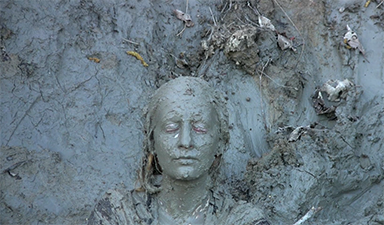
Elyse Portal, Sudbury, Ontario
Biophilium Research Mentor
I am a settler in Canada of Ukrainian, Baltic, Mennonite and Irish heritage. My work revolves around climate crisis endurance exercises that respond to climate uncertainty, land-use changes, and biodiversity loss with sensual research, ecological materials, reciprocal pigment foraging, other-than-human invitations, climate narratives, and socially-engaged ecoart practices. Living within the territory of the Atikameksheng Anishnawbek in N'Swakamok (Sudbury, Ontario), I recognize that colonialism and mining interests led to the creation of the Robinson Huron Treaty of 1850. Mining impacts directly effect the context in which I work, including the tensions among fallout of historical nickel smelter pollution, heavy metal levels, mass tailings ponds, as well as an immense community-engaged regreening project remediating the land through the re-alkalizing and planting of 10 million trees, described in my personal and collective work as part of ee portal.
I have been part of the collaborative ee portal since 2011. Our work mnemonic for the commons, initiated at the Burren College of Art - one of the longest-standing art and ecology programs in Ireland, continues to influence our practice, including the book art series we are currently developing with flask publishing.
My current projects are soil colour carbon sink, bog-moss-lettuce, and sounds are pigments are places, funded by the Canada Council for the Arts and Ontario Arts Council. |
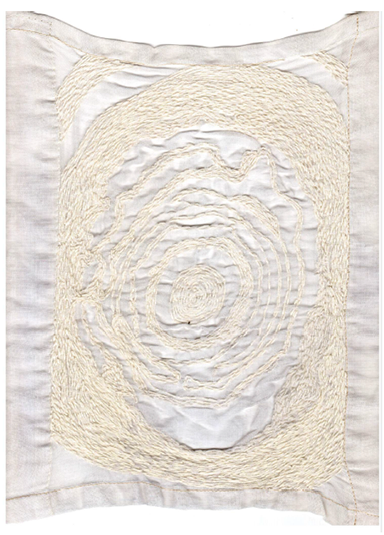
Zoe Handler, Littleton, CO
I am a writer, musician, and visual artist living and working in my home state of Colorado.
Following the experience of caring for both of my dying parents, my practice has become an intentional way of reaching back through time to be with them. This intimate relationship with mortality has also guided me towards deathwork.
Much of my visual art practice is an attempt to translate the raw weight of loss onto material. Primarily I work with textiles, a medium that carries a profound ancestral lineage, as my mother taught me much of what I know about working with cloth. Also part of my lineage is the Jewish ritual of Kriah: the deliberate tearing of clothing before the funeral begins to symbolize the rupture that has occurred through death. We are taught there is a time for tearing and a time for mending. Through cloth, I am able to inhabit both the rupture and the repair.
I am deeply preoccupied with questions of kinship, caregiving, home, love, decay, mortality, awe, repair, and grief. At times the weight of my questions feels unbearable, but the labor of wrestling with words, thread, and sound provides solace — Through the act of creation, I am able to feel the enduring interconnectedness of all things across space, time, memory, and death.
|

Erin Dengerink, Vancouver, WA
My artwork strives to be comforting, healing, and helpful. It is part joy, part catharsis, and always seeks the sublime.
A recurring theme in my work is Love and Loss. Over the years, I have developed a series of small sculptures with a focus on healing. I think of the objects as talismans; objects that give strength or bring luck. They are a balm for things that have no cure. They are tiny tools for finding peace.
Combining and altering personal objects that I have collected is how I make much of my work. Many of the materials in my sculpture are the debris from medical treatment: the vials that medicine comes in, the glass tubes from syringes, and pills. Those objects can have a negative connotation. They allude to illness, pain, and uncertainty. As a means of coming to terms with that uncertainty, I embrace those healing objects;
I make them silly,
I make them beautiful.
I combine them with rocks, flowers, toys, and other objects to bind them to the mundane of everyday.
All the components of the work have been touched, used, loved, and worn; any clinical cleanness and intimidating newness has been rubbed off.
The artworks are as whimsical as they are weighty.
|

Judith Duncan, Sudbury, Ontario
“When I am a hundred and ten, everything I do, be it a dot or a line, will be alive. “. Katsushika Hokusai
My creative practice…
… began with expressive art. My early encounters with dying children transmuting their understandings of death viscerally with expressive art and play. That has been their continual gift to me.
…in Sudbury, integrates both community arts and studio work. Community art projects dedicated to positive change enrich my practice. Critical to my personal growth as an artist were the cross-cultural collaborations: “Mwalimu” (Kenya) and “The Hollow Bone Hunter.” With study/ mentorship I expanded my material practice through mixed media arts, particularly plaster. Making by embedding ephemera, text, images and marks into multiple veils of plaster allows for life stories to simultaneously emerge and fade over time. “Judiths work is playful, highly imaginative and a joy to look at. There is a childlike quality and vulnerability that comes from her work with kids.” Since 2014, I have been exhibiting these works in Northern Ontario, including at the Sudbury Art Gallery and Gallery 6500.
… is evolving in exciting ways, now with a crone gaze. I look to my own backyard for wild materials to enliven my practice, strengthening my artistic agency through creative entanglements with human and non human collaborators. I am animated through transformative liminal processes, including fermentation, charring, and other natural pigment processes- rooted in respectful and sustainable practices. Listening with senses and responding through art. HOORAY! |

Yael Haskal, Berlin, Germany
Grounded in philosophies of ritual and communal exchange, I create performances that animate morbidity with whimsy. My theatrical work fuses lyrical language, absurdist imagery, and DIY spectacle to cultivate spaces for collective curiosity in dark waters. Through playful storytelling, I facilitate imaginative engagement with topics we are taught not to discuss over dinner.
My mediums include theatre, puppetry, photography, poetry, and video. Through high-contrast aesthetic interventions, across these domains, I engage with the mundane and the macabre as sites of hidden truth. My work places sheet ghosts in cemeteries, violence in claymation, depression in clownface, and grief in magic tricks. While in residence at Mortem, I am conducting research for a theatrical gravedigging ritual that cultivates collaborative dialogue about mortality.
|

Danika Azevedo, Montreal, Canada
I am a queer, trans-non binary emerging artist. I was born and raised on the East coast. I work in many different mediums; including textile, ceramic, tattoo, drawing, painting, silver, leather, and printmaking. I like telling stories through imagery, dyeing, textures, and shapes, as well as the material I use, which is almost exclusively recycled and upcycled material. I am currently turning my focus to my textile and fibre practice.
Textile work is slow, meditative, and repetitive and it provides time for deep thought. My time creating has helped me process and acts as a container for self reflection. I love the stories and aesthetic that can be expressed through textile. Motifs that I continuously come back to are queerness, plant life cycles, grief, decomposition, waste, and the interconnectedness of seasons and changes.
Everything I consider is through a queer lens and experience. Queerness and life and death have always been deeply intertwined. Queerness is beginnings, changes, transition, regeneration, joy, loss, family, and celebration.
Plants are a constant muse. I use them visually both literally and symbolically. Dead plant material is also used to create beauty through colour and stain. Plants are used in both fresh and dried form as dye, and the spent material will then be used to create pigment for inks. Dyeing has taught me about care and preparation through the complex process of naturally dyeing. The nurturing and processing of the fibre has also taught me to be open to possibilities because the outcome is often changing and surprising.
Recycled fabric is another way I incorporate the life cycle theme by giving a second life to discarded materials. Through mending, dyeing, composition, and a change of context, meaning and importance can be assigned to something unvalued. All the fabric and fibre used has come from plants or animals and will easily decompose and return to the earth.
I learned how to sew in 2020 because I had dreams of making a quilt. I have been an avid quilter ever since. I am drawn to quilts because they are about relationships. They have stories woven into them and create new stories and narratives. They are a collection of events and experiences. They are sometimes heirlooms and generational. They are also warm and calming. They ease mental heaviness while simultaneously providing physical heaviness that can act as a salve. Blankets have a symbiotic relationship with their user; they hold you while they are being held by you. They create feelings of fullness. Quilts are often undervalued because they are seen as domestic, as ‘craft’. Quilts, However are fully rounded, artful, and a resourceful form of creating, sharing, caring, and storytelling. |
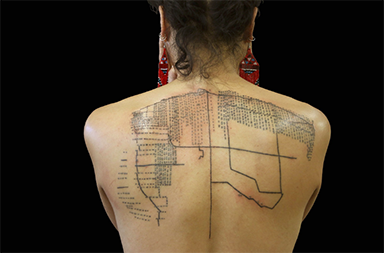
Afuwa, Vancouver, BC
don’t be afraid of the dark forest. just know that some things are not meant to be understood.
have faith in the machete, and be strong in your heart/mind.
look back often, but go forward always, until you can go no more. you are never alone. |

Katja Mater, Amsterdam
My practice investigates how images shape—and distort—our sense of reality. Both my dyslexia and my queerness inform the working methods: language is approached visually, perceiving words as shapes and time as layered rather than sequential. This temporal logic runs through a hybrid practice, where photography, film, drawing, performance, sound objects and installation intertwine. By subverting the use of language, the act of writing and (optical) media, the work reveals the glitches, layers, and temporal shifts hidden within them.
In 2022, both my parents passed away shortly after each other. The overwhelming feeling of grief that followed caused a total loss of time. I started filming, to archive, but also as an attempt to capture the bizarre moment between life and death. Since then death and grief slipped between the cracks of my practice and I decided to embrace it with both arms.
Next to my solo practice, I am involved in different queer and feminist collaborative projects as editor of Girls Like Us Magazine since 2014 and as one of the founding members of Mothers & Daughters, a Lesbian* and Trans* Bar since 2017. |

Albertine Carle, London, UK
Since early childhood, my love of arts and sciences have coexisted, reinforced each other, and in picking careers competed with one another.
My studying of Biomedical Sciences followed by an MSc in Cardiovascular Medicine developed my fascination with anatomy and the innerworkings of the flesh which I have nourished through reading books such as those by Dr Richard Shepherd, purchasing a suture kit, and frequenting pathology museums like the Viennese Narrenturm.
A relationship I’ve been exploring through my recent work is the intersection between girlhood and the flesh; the performance, the viscerality, the morphing and the decay.
From the remains of a fox’s dinner on the street to pictures of myself as a child or bruises and scrapes acquired on a night out, flesh connects us all.
I feel no discomfort around death, having shadowed within the operating room and hospice and attended numerous funerals.
I find rituals surrounding mourning distinctly beautiful from Victorian shrouded urns to medieval saintly reliquaries and believe the dead deserve immense care as there is no state more unguarded and fragile.
Being currently undecided whether to professionally pursue art or undergo a mortuary assistant training programme, this course would provide invaluable knowledge and inspiration. |
Gabrielle Mulholland, Brooklyn, NY / Montreal, QC
Through a wide range of media, from writing and perzines, to printmaking and game studies, my work explores the impact of traumatic memory through our relationships to time and place. My inspiration comes from both the somatic experiences of time passing, to its markers on our natural world, whether they’re found in the thick of nature, the dense urban landscapes where I have been born and raised, or the neglected third spaces where these collide. With a background in illustration and print making, I relish in the creation of a visual language that gives shape to the grief, loss and hope that lives inside each trauma survivor, using my fine arts background to record a time in this life. |
Miranda Newman, Toronto, Canada
I’m a bestselling award-winning nonfiction author (ROUGH MAGIC, McClelland & Stewart, 2024) and journalist whose work focuses on psychology, identity, healthcare, disability, and lived experience. My artistic practice is driven by the idea that personal narratives and concise reporting can demystify complex human realities and transform isolating experiences into shared and nuanced opportunities for connection.
I work within the intersection of literary arts, healthcare advocacy, and trauma-informed community building. My creative environment is shaped by my identity as a queer, disabled writer. I’m committed to producing work that reframes culturally challenging subjects like grief, death, and trauma through nuanced, accessible, and socially engaged nonfiction. My artistic practice grapples with systems of care and harm, from psychiatry to palliative care, and is deeply informed by my role as both a writer and peer support provider within communities that experience marginalization and medicalization.
“The End” will be my second essay collection. The research-intensive structurally ambitious nonfiction collection will combine memoir, journalism, and cultural criticism to explore topics like what we can learn about death acceptance from Ukrainian cultural rituals and attitudes, the bureaucratic systems surrounding dying and its role in grief, and dying in a society that prioritizes productivity. |
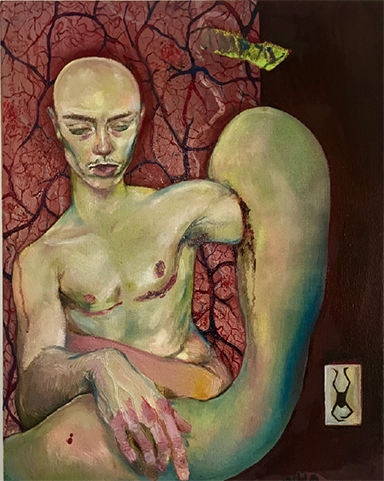
Emmett Bristow, Toronto, Canada
Having graduated with an MA in Fine Art at Central St Martins, London, UK in 2024, Bristow continues to untangle grief, curiosity and queerness through a multi-faceted, regurgitating practice. Bristow’s sculptures in particular are concerned with the organic decomposition of the body as a source of power. A reverse ‘becoming’ that challenges the constraints of Late Capitalism through mess and re-articulation. Bristow’s sculptures are thought of as corpses in their own right; created by the Artist as stand-ins for the body of his brother, who he lost in 2018 and who’s body he was unable to care for. The notion of ‘stuck’ grief is explored through sculptures with their own disrupted life spans, being destroyed, re-worked and reinstalled; forming their own cyclical death. Bristow’s paintings grapple with a sickly pallet of rich greens and pinks whereby self-portraits render a small death for the Artist, one that represents transness and organism transgression with equal concern. His Essay ‘Can the Corpse Speak’ which was published in 2024, posits the decaying body and the trans body alike as historically repressed instigators of a world liberated from value through a fixed image of the body. Now living in Toronto, Canada and working without a studio, Bristow is returning to painting, graphite, and poetry disseminating various symbols such as keys, iris-less faces and found text through each medium, building a self-feeding world where grief feels safe to access, and loss is fragmented into measured chunks of creation.
|

Christina Lett, Midland, GA
My work explores grief as a response to change: the evidence that something mattered, something shifted, and we were changed by it.
I am interested in thresholds - the spaces between what was and what comes next. Death is one of those thresholds, but it is not the only one. Relationships end and begin. Bodies change. Identities expand. Possibilities disappear. Beliefs collapse. Love alters us. Even joy can ask us to release a version of ourselves we no longer need.
Through painting, mixed media, and story, I make work from these moments of transition. I am drawn to images that hold both tenderness and unease: animals at the edge of something unknown, bodies transforming, objects carrying memory, beauty growing alongside loss. My work does not try to resolve grief or explain it away. I want to give it form - to make the invisible weight of change tangible enough to sit beside.
My practice is rooted in the belief that grief is not only about death. It is part of being alive in a world where nothing stays exactly as it was. I make work from that impermanence: noticing what changes us, metabolizing what remains, and offering something back. |
| |
Nature Mort:
The Natural History of Death
January 2027
|
|
 |
|

Alexis Williams, Ottawa
Director of the Biophilum
As an artist whose work is always expressing the value of life and living systems, the taboo against death as a conversation topic has not stopped Alexis from contemplating mortality in her performance, lab, wildlife photography and studio work. Everyone can do it, but artists have a particular advantage as practiced creative players: we have a profound freedom to invent mourning rituals and regularly renegotiate our relationships with the dead, which Alexis celebrates and encourages in others. She is curently making objects whose sole purpose is to reveal the magic in all mater, living or dead and the devine in every moment, banal or ceremonial.
|

Ashley Czajkowski, Arizona
Biophilium Research Leader
Professor of Death and Photography at Arizona State University
The human relationship with nature is a tenuous one. We are at once a part of the natural world, yet intentionally set apart from it. I am interested in this disconnect; our refusal as a species to admit that we, too, are animals. There is a sense of savagery that comes with being an animal, being wild. We have been taught to become something other, to become domesticated. There is loss in this becoming. Though all experience this (false) dichotomy between humans and nature, the accepted social construction of femininity is much further removed from the nature of the human animal.
Historically, women who exhibited wild, uncontrollable, or generally undesirable behavior were considered dangerous and mentally unstable. Witch hunts and medical disorders like hysteria illustrate the collective psychoanalytical fear of the “female monster,” and this chastising of unbecoming female behavior lingers to this day. Because femininity is the gender I learned to perform first-hand, the relationship of women and nature is highlighted in my work, drawing connections to sensuality, fertility and the maternal instinct.
Exploring these intrinsic, wild tendencies deep-seated in us all challenges societal expectations of women and men, our relationship to the natural world, our own corporeal existence, and ultimately, our mortality. I'm interested in how harnessing these innate primal desires presents the possibility of reclamation; of re-wilding the human, of unbecoming. |

Jay Davani, Providence, Rhode Island
Biophilium Research Leader
I am a death-curious artist exploring how to use my creative
talents to help people who help people. I started taking film photos in 2003 and still maintain an intentional approach to shooting. A huge part of my photography practice is bringing attention to what others can't see or don’t want to face. I am drawn to capture moments that are painfully beautiful and where symmetrical order exists inside disorder. My work is of many, but unlike most.
More importantly, I'm a storyteller.
I invite my audience to consider life's most profound questions through my captions derived from personal experience. A few years ago, I returned my practice to black and white format to focus on composition. My photography is an expression of who I am, what I'm feeling, how I think, and what I see. Whether it's a shadow or fleeting moment, I prefer shooting in natural light. |
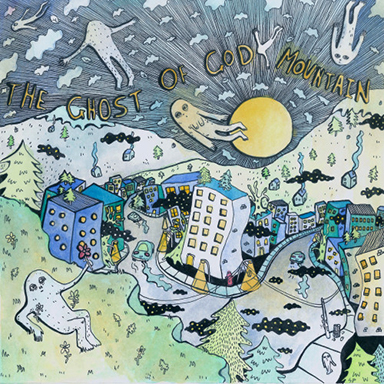
Shannon Pot, Gatineua, QC
Shannon Pot is a teaching artist and researcher living between Ottawa and Montreal. She works in fibre arts, drawing, painting, collage, and sculpture, with a focus on connecting to local ecology through observational drawing, material, and narrative. She completed her MFA in Drawing with a Social Practice and Community Engagement Minor at Emily Carr University of Art and Design. She is currently completing her Masters Thesis in Art Education at Concordia University where she focuses her research on the historical and current archival practices used at the Canadian Museum of Nature, and how they can be used as pedagogical methods for arts based environmental education. She works as an Art instructor in the youth and adults programming at the Ottawa School of Art, as a research assistant and freelances on Arts / Science collaborative projects. She loves animals, and is more than happy to walk your dog for you. |
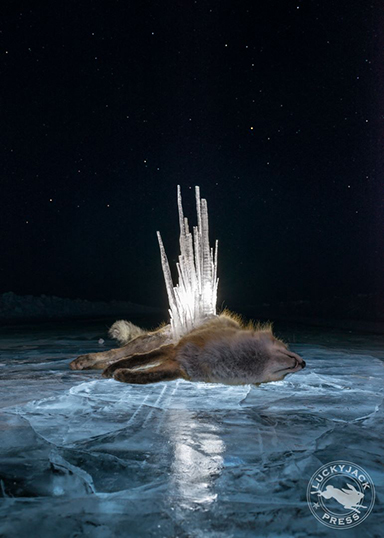
Marcus Jackson, Yellowknife, Northwest Territories
I haven’t always been interested in dead animals. My obsession didn’t really start until I was mid‐way into my thirties. I’d never held a wild animal still warm and caked with the musty scent of the forest until I gathered a broken coyote off the side of a rural highway. Since that first intimate encounter with a dead animal, I’ve felt compelled to re-create that experience to more closely examine my emotional response to animal deaths caused by humans.
I am fascinated by roadkill. The spectacle of the accident motivates me to make work; the process and interpretation for the final pieces is inspired by the traditions of memento mori, vanitas, ritual, and ceremony. For me, there is something beautiful and tragic about the corpse of a wild animal. Death is but a historical record inscribed within and upon a body. The corpse of a wild animal is more than simply an empty spirit-vessel, it is the exquisite tablet from which the story of an animal’s life can be read. I am attracted to the juxtaposition of tragedy and beauty and try to create works that evoke an emotional response from the viewer.
I salvage road-killed animals and birds and use them as subjects in my work. I arrange them as a still life, then photograph them. These photos sometimes become intaglio prints: the process of drawing and plate-making provides time to meditate on the relationships humans have with wild animals. Cultural identities are shaped by our understanding of animals and our concepts of wild and wilderness. We invent terror and anthropomorphize non-human kin to justify our colonization of the animal kingdom. My work explores how wild animals contribute to cultural narratives of death while also challenging human anthropocentrism. Creating images with the corpses of wild animals asks viewers to look upon the bodies we revere in myth and folklore yet leave rotting in the wake of our existence. |

Nova Nachtom Mautner, London, UK
|
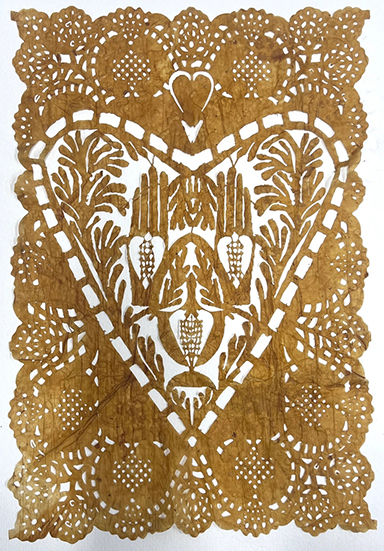
Alba Arillo Garcia, Helsinki
My practice explores death as a material, sensory and ecological condition. Working across design, textiles, material research and scent, I investigate what happens to bodies, objects and meanings when they move beyond the human desire for permanence.
I am particularly interested in the garment as a covering and a companion: something that transforms with the body through dying, burial and decomposition, rather than separating it from the processes that follow. My work experiments with biodegradable materials, funerary garments and speculative rituals designed to return matter to living, multispecies, systems. Decomposition becomes both a physical process and a way of thinking about care, intimacy, memory and transformation.
Alongside material research, I am increasingly exploring the role of smell and touch in encounters with mortality. Scent can linger after a body has disappeared; materials can carry traces of contact, decay and place. These invisible and intimate qualities allow me to approach death not only through representation, but through sensory experience.
My practice sits between artistic research, material experimentation and death studies. I am drawn to the spaces where scientific knowledge, ritual, folklore and embodied experience meet, and to the possibility of making death less distant by approaching it with curiosity, tenderness and ecological imagination. |

Emilia Berlind, Stockholm, Sweden
Through my work, I invite viewers to engage with intimate, sometimes uncomfortable subjects. I explore themes of mortality and morality, with a current focus on environmental issues and ecological grief. I am interested in the role art can play in making the climate crisis emotionally tangible and personally relatable. Rather than communicating through scientific data, I explore the human emotional landscape in all its flaws and contradictions: how do we live with our guilt as killers of the natural world?
I create tension within my compositions through contrasting materials and their inherent connotations. My work ranges from wearable to unwearable sculpture and is often presented as installation, creating an immersive relationship between object, body, and space.
Rooted in traditional craft practices such as gold- and silversmithing, my work draws on the language of jewellery and corpus, particularly the ritualistic and symbolic use of objects. I position my practice within body-related art, using the tactile and sensory qualities of materials to evoke intimacy, vulnerability, and unease. Through the physical encounter with my work, I seek to create a space where difficult questions can be felt as much as contemplated. |

Vanessa Iafolla, Dartmouth, NS
My artistic practice explores themes of grief, death, and life post-mortem. I am trained in ethnographic research and rely upon this training in my artistic practice, which explores cultural approaches to death and memorialization, including posthumous collaboration. This aspect of my practice developed in response to the death of my younger brother, Tristan, who died in 2024, in a car accident in Utah while on vacation. I am interested in the way death and land interact through legal structures, cultural practice, and individual experiences of death and grief. I have used plants grown by my brother, who was a landscaper with particular interests in native flora and fauna, to process photographs of the Utah landscape and make anthotypes of him. I have created a series of soil chromatograms using dirt taken from the site of the car accident, his last home, and his gravesite. I am currently working on a series of salt print photographs made using salt taken from Great Salt Lake; future plans for my art practice include making environmentally-friendly gum bichromate photographs using alternatives to potassium dichromate, and to use pigments I have made from soil harvested from places identified on his road trip in Utah. |
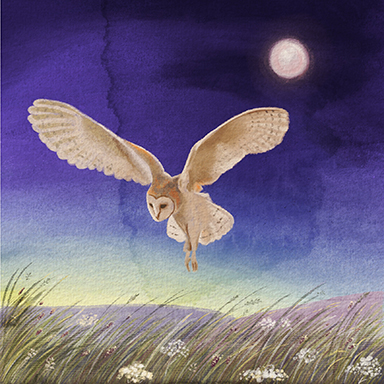
India Bird, Todmorden, West Yorkshire, UK
I am a painter and author-illustrator. I have completed and published two books, Part of Everything and Among Wolves, and I am the published illustrator of Pamela Pottinger’s The Sea and the Moon. My work combines playful, surreal imagery with ‘big’ topics. I am interested in how visual language can transcend language, social, and cultural barriers and make intimidating subjects feel accessible, without diminishing their depth. I create world that sit slightly askew from reality, and are softened by imagination. My work reflects my environmental ethics, and my belief that it is only by addressing our fears that we can cultivate a healthy relationship with them. I believe that birth and death are the most important times in our lives, and yet all too often, people are abandoned in the latter. We need to do better, and so my intention is to create work that helps to break down these barriers and come to terms with the most natural inevitabilities of death and dying. |
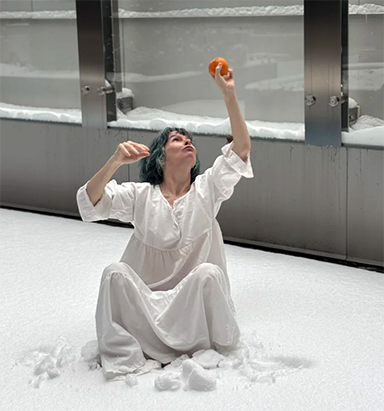
Shannon Quinn, Toronto, Canada
As an artist, I am interested in how language manifests in images along with the dialogue of whispers, echoes and contradictions it creates.
There is an expansiveness to how images have power to change the tone and rhythm of a poem.
Ultimately, I look for inflection points where vulnerability is revealed. I am hopeful that what might be uncomfortable can still be viewed with empathy. In my work I frequently return to themes of devotion, water and breath which is to say birth—the arrival of a shared experience, the movement from isolation to connection. |
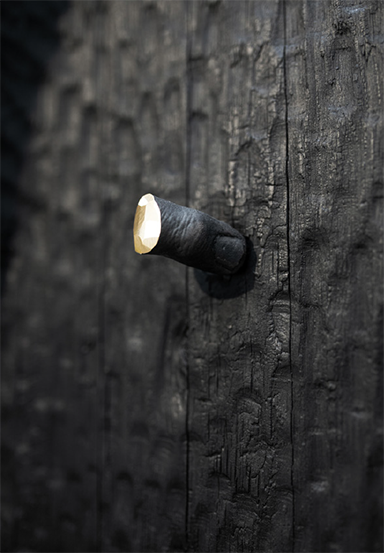
Pia Stjärnvind, Stockholm, Sweden
I think of my work as physical poetry. Through sculpture, installation, sound and spatial interventions, I explore time as something material: layered, embodied and present within matter, places and bodies. Rather than understanding time as linear, I am interested in simultaneity — in how the past, present and future can coexist within a single moment.
My work often begins with physical encounters: an object emerging from the earth, a branch, a body, a place marked by repeated human presence. These become points of departure for investigating memory, loss, transformation and what remains.
Repetition and ritual are recurring methods in my practice. I work intuitively and through listening, allowing materials and processes to resist, redirect and reveal connections rather than imposing them in advance.
Increasingly, I am interested in the human being not as the centre, but as a participant within a much larger field of relations — between matter, geological time, memory and existence.
I create spatial situations where these different temporalities can briefly become tangible: thresholds between what is visible and what is already there. |

Sara Rothwell, London, UK
I am interested in what happens when something reaches the end of one form and begins another: body into bone, grief into memory,
inherited material into a new object, death back into life. Increasingly, I am drawn to the space between those things, the threshold where
something is no longer what it was but has not yet become what it will be.
Death, grief, burial and decay all occupy this territory. I am interested in what happens when we resist the urge to resolve these spaces and
instead stay with the uncertainty of what is becoming. I feel we are living collectively within such a threshold now, where old structures are
breaking down while what comes next has not yet fully taken form. For me, this space is not only uncertain, but incredibly fertile.
I have buried dead animals since childhood. What began as an instinctive act of care and acknowledgement continues within my practice
today. I allow the earth and time to do their work before returning to recover the bones, which may then enter another transformation through
casting, precious metal and jewellery-making.
I don't see bone simply as a material. It carries evidence of a life. Flesh disappears, but structure remains. Bone holds both impermanence
and permanence, a reminder of mortality and of having existed. |
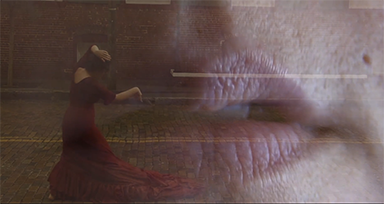
Niurca Márquez, Miami, Florida
At the core of my work is a simple premise: the body is both archive and instrument. It carries personal, cultural, and spiritual histories that, through movement, become active, negotiated, and transformed. For this reason, my work begins with listening to the body, to the space it inhabits, and to the histories that move through both. I approach choreography as a ritual practice and a form of inquiry, treating movement as a way of knowing.
My practice unfolds at the intersection of ritual, improvisation, and research. Drawing from flamenco lineages, Afro-Cuban movement traditions, somatic practices, and contemporary choreographic inquiry, I explore how the body navigates multiple systems of knowledge at once; an approach shaped by my upbringing in Miami, where cultural crossings are lived daily.
In the studio, I work with “incubators,” structures that place dancers within specific conditions. Through deep listening—to self, others, and environment—movement emerges rather than being imposed. Spontaneity becomes a cultivated response.
I am interested in how choreography reveals relationships between bodies and environments. By tuning into the histories embedded in place, movement becomes a way of reading and responding.
Ultimately, my work cultivates awareness of the forces shaping our gestures, the histories we carry, and the possibilities that emerge through attentive relation. |

Ecem Omeroglu, Istanbul, Turkey
''I am an Istanbul-based landscape designer, archivist, and researcher whose practice sits at the intersection of spatial practices and gardening. I follow plants as carriers of memory and loss—how they root, hold on, attend, and sometimes refuse. Through cultivation, photography, field observation, and archiving, I explore how landscapes enter everyday life and how gestures of care connect personal loss to other species. Repeated visits, seasonal changes, and the daily work of tending become ways of staying with absence.
I work with what remains beyond written records: bodily gestures, displaced plants, and encounters that gain meaning through repetition. In my practice, plants become the method—bodies that hold what human record-keeping cannot. I study plantae units across different scales and contexts, examining interspecies relations and uncovering the layered data of the plant world. My practice follows connections between landscape, memory, and the individual, focusing on how plants survive, hold histories, and transform spaces.'' |

Ava P Christl, Harrison Hot Springs, BC
My work, spanning over 30 years, lies at the intersection of art and ecology, nature and spirit. I make paintings about nature and place; nature as healer; and about our human relationships to the living land. My work deals with landscape and memory; grief, loss and recovery; longing and belonging; and the concept of entropy as it relates to land and water.
I now want to shift and deepen this work to include the human landscape; to work with people in all conditions; to address grief and loss on a human scale. I have recently studied to become a death doula, and have witnessed and mourned many deaths among family and friends in recent years including death by suicide. Now, I am interested in finding ways to bring my artwork into the realm of the dying and the dead. I want to shift ideas of grief, loss, and mourning from the ecological context to the human. I want more than prayer and ritual. I want a palpable, visible expression of death and dying - an art of mourning and honouring. |
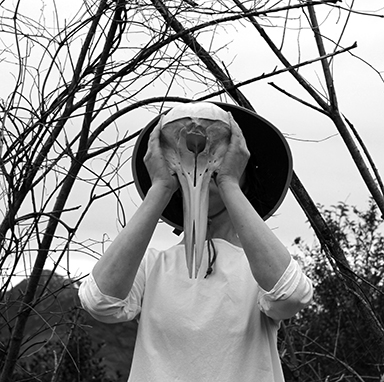
Meg Miller, Isle of Skye
My practice is rooted in the coastal and island environments of the Isle of Skye. I work through making, observation and discovery, allowing materials, processes and encounters to influence the direction of the work.
Walking and beekeeping are important ways of paying attention to place. The natural rhythms and cycles of growth, change, decay and renewal are part of everyday life and inform the way I work and make.
Materials and processes emerge in response to the work as it takes shape. Their qualities, together with the act of making, are central to my process, allowing ideas to develop through direct engagement with materials, landscape and experience. |

Katy Flammia, Hudson NY,USA
I want to see the world and all that is in it as living, unique and overlapping beings, each part of other beings and systems. Painting is a practice that helps me unlearn the separation and hierarchies in our culture.
Life persists through a constant recombination of the animate and the inanimate, and perhaps, at a different scale or duration, even the inanimate can be animate. I think about how perception shifts based on our place in the world, our movement through space, and our changing points of view.
Do we experience a ceaseless passage of time and the influences this passage has on the world around us, or can we be held in a moment that extends forward and back, something vast, something that hovers and holds? Can we experience both together?
My work is an exploration of the fluidity of existence, where the insistence of the eternal and the fragility of impermanence converge. I am interested in the moments when things transition from one state to another.
Those moments of intricate intermingling of our inner and outer worlds, can access hidden dimensions of our perceptions and emotions. |

Natalie Field, Trondheim, Norway
Natalie Field (b. 1982) is an interdisciplinary artist creating site-responsive sculptures, installations, and ritual encounters using skin and bone as material and method. Working within the field of speculative taxidermy, her animalARTefacts investigate cultural, ecological, and multi-species entanglements shaped by biodiversity loss and extinction. Through processes of handling, transformation, and display, her practice attends to the animal body as a site of death, ritual, and mourning, exploring how relationships to the other-than-human are mediated through systems of knowledge, care, and representation. Her work extends into photographic processes as sites of bodily encounter, re-materializing archival and representational traces of presence and absence.
Field’s work has been exhibited internationally, including at the Medical Museum at St. Olav’s Hospital and Ringve Music Museum in Trondheim, and the National Museum of Wildlife Art in Wyoming. She is a Creature Conserve Fellow and a recipient of the Masterstipend from Museene i Sør-Trøndelag (MiST). She holds an MFA from the Trondheim Art Academy, Norway, and a B.Tech in Photography from Nelson Mandela University, South Africa. |

Monika Kinner,
Saskatoon / Jackfish Lake (both in Treaty Six Territory)
Monika Kinner (b. 1970) is an interdisciplinary artist based in Saskatoon, Canada. Working with fibre art, analog photographic processes, spoken word, installation, and what she describes as, 'en plein air poetry', Kinner explores the intricate relationships between humans and the natural world.
Delving into the concepts of confinement & resistance, diversity & vitality, displacement & kinship, communication & reciprocity, regeneration & transformation, Kinner draws on life experience, deep observations, and formal education. Overlapping Humanities with Botanical Science, Kinner offers a unique perspective paralleling the interconnectedness of the human / flora experience.
Deeply inspired by her Motherline, she strives to explore the universal themes of identity, communication, memory, and belonging specifically through a lens of non-hierarchical, non-violent reciprocity. She considers the Prairie her Muse, and the Bees her Mentors. |

Katie Stubblefield, Long Beach, California
Katie Stubblefield creates woodcut prints, oil paintings, sculptures, large-scale drawings, and site-specific installations that trace entropy: the slow collapse of order into chaos that also drives death and decay. Growing up in Tennessee's old-growth forests before relocating to Southern California, she developed an early fascination with tracking wind through tree canopies, an attention to unseen forces that has grown into a broader inquiry into mortality: how do living systems break down, and what emerges from their ruin.
Her imagery draws on site visits, forensic photography, first-hand accounts, and evidence of environments transformed by super-sized storms and climate change — landscapes that read as crime scenes of ecological death. Working in traditional materials and repurposed substrates like discarded plexiglass and sailcloth, she transforms environmental debris into layered studies of collapse and renewal, treating wreckage the way an investigator treats remains.
Recent work examines dust devils and updrafts as real-time indicators of an over-heated climate, overlaying flood zones and fault lines with local infrastructure. Sculptural installations incorporating fishing nets, concrete, rebar, and architectural debris freezing moments of environmental death, asking what persists, or emerges, in devastated ground. |
Jency Sekaran, NYC
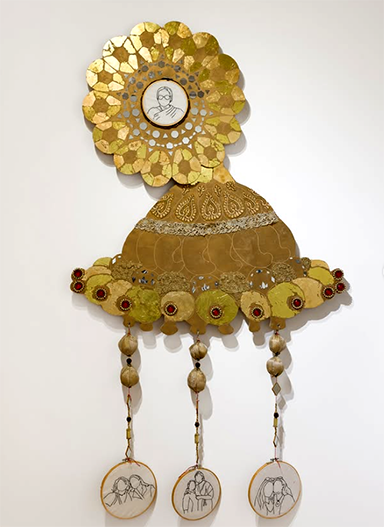
Jency Sekaran is a New York City-based multimedia artist exploring themes on intersectionality of identity. Combining many different techniques such as printmaking, embroidery, and ceramics, Sekaran is able to depict stories of the complexity of being a third culture person in America.
Being an Indian woman in America, Sekaran struggled with adhering to both cultures which led her to create her own culture, a third culture. By depicting the female form breaking free of cultural and societal ideology, Sekaran evokes emotions of acceptance of multiple identities and freedom of choice.
In 2013, Sekaran received their BA in Art and minor in Biology from Augusta University, however, being raised by Indian immigrant parents, she followed her parents dream of being in the sciences. Receiving her Master in Public Health in 2017 from Georgia State University, science has heavily influenced her art by incorporating organic chemistry and beakers serving as a container for memory and emotion.
In 2023, Sekaran had her first residency and solo exhibition, ‘She is....’ at Carroll Hall in Brooklyn, NY. She currently is represented by Atlantic Gallery, and has been in multiple group shows in New York City. Sekaran has been published in the Canvas Rebel and the Artist Talk magazine as well as been on the Scouted podcast.. |

Melissa Cole, Calgary, Alberta
Traditionally, botanical illustration has tended towards the science of botany with a lesser focus on fine art or beauty. Nevertheless, most plants are things of beauty unto themselves, and as such, easily become works of art when painted with the precision and observation required of botanical artists.
My attraction to botanical illustration stemmed from an interest in southern Alberta’s native plants and ecology. Botanical illustration requires thorough observation of live specimens to create a scientifically accurate representation of the subject; once the flowers have withered and the leaves dropped the illustrations are essential tools for identification and study. While my paintings follow these scientific tenets, my background is firmly planted in the world of fine art. It is natural then, that my priority is to create pieces of art, while keenly observing plants and their place in the natural world.
By using dramatic lights and shadows to create depth and three dimensionality, my aim is to bring a plant to life on paper. My process involves quick sketches, dissections and colour studies; each component of the plant must be meticulously measured to create a detailed scale drawing before painting can commence. Working in watercolour, I use layers of subtle washes to build depth and volume before recording fine details.
This lengthy and detailed process brings me closer to my subjects, and has underscored the complexity of the natural world, and just how vulnerable and precious natural ecosystems are. |
Liz Rae Dalton
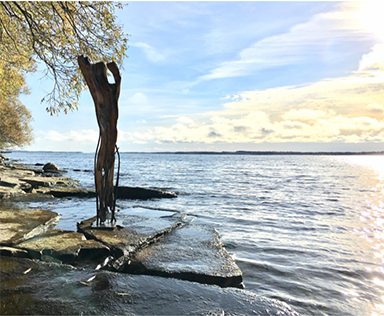
For decades, my life on an island near Kingston, Ontario, provided inspiration and materials for art-making. A walk on a shoreline was a gathering opportunity. Surrounded by fields, water, and sky, my compulsion to carve, paint, and draw took hold.
Soon, I’ll weave collected bits of stone, bones, and feathers into a new installation. With this new work, birds will sing. Tall pieces of carved shoreline wood layered with molten encaustic paint may suggest shadows. It will be a story within a story. A little bit of Good Night Moon with a mythical raven on the side.
My art is an opportunity for adventure with ideas and materials.
Mother Nature is my guide. |
Alyssa Rose, Portland Oregon
For seven years my studio has been other people's living rooms, yurts, beaches, forests, and grief circles, wherever a community needed a place to lay down and honor what had died, what had changed, what uncertainty lay ahead. I am a grief guide and ritualist based in Portland Oregon. My medium has been community ritual itself. A place and a way of building trust, resilience, and capacity for a people to turn towards each other in their darkest, most challenged life moments. A place that can feel bottomless until we find a riverbed of belonging, a river bed strong enough to hold us in our descent and to celebrate us when it’s time to surface again.
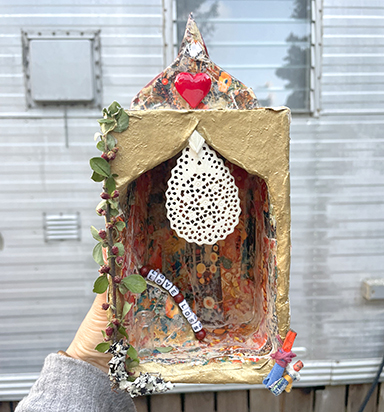
These rituals vary in shape, size, and sound, yet some things stay the same. One thing that stays the same is that they all involve an altar. A creation, a place upon which we set some of our grief, some of our hope, some of our ancestry, some of our longings down. A place where we visiblize these things, remove them from being held alone within us, and allow them their own space in which to be in relationship with them.
What I'm hungry to make now are altars that hold physical, standing objects of death and remembrance that don't dissolve when the ritual ends. These altars create a space for meaning making, a space for tending our love, our longing, and our losses. These altars are invitations and they last long beyond the ritual itself as a talisman of integration. I want to learn from death workers and artists in how to create beautiful spaces for tending grief and cultivating remembrance in our lives. |

Christina Lett, Midland, GA
My work explores grief as a response to change: the evidence that something mattered, something shifted, and we were changed by it.
I am interested in thresholds - the spaces between what was and what comes next. Death is one of those thresholds, but it is not the only one. Relationships end and begin. Bodies change. Identities expand. Possibilities disappear. Beliefs collapse. Love alters us. Even joy can ask us to release a version of ourselves we no longer need.
Through painting, mixed media, and story, I make work from these moments of transition. I am drawn to images that hold both tenderness and unease: animals at the edge of something unknown, bodies transforming, objects carrying memory, beauty growing alongside loss. My work does not try to resolve grief or explain it away. I want to give it form - to make the invisible weight of change tangible enough to sit beside.
My practice is rooted in the belief that grief is not only about death. It is part of being alive in a world where nothing stays exactly as it was. I make work from that impermanence: noticing what changes us, metabolizing what remains, and offering something back. |
| |
Mortology:
The Anthropology of Death
February 2027
|
|
 |
|
Alexis Williams, Ottawa
Director of the Biophilum
As an artist whose work is always expressing the value of life and living systems, the taboo against death as a conversation topic has not stopped Alexis from contemplating mortality in her performance, lab, wildlife photography and studio work.
Everyone can do it, but artists have a particular advantage as practiced creative players: we have a profound freedom to invent mourning rituals and regularly renegotiate our relationships with the dead, which Alexis celebrates and encourages in others. She is curently making sacred objects whose sole purpose is to reveal the magic in all mater, living or dead and the devine in every moment, banal or ceremonial.
|

Sarah Rachael Wainio,
I Carry You With Me began with an obsession with a physical artifact: a ring recovered from the wreckage of crash of United Flight 93, worn by my sister Elizabeth the day she was murdered, September 11, 2001. Ever since she was violently ripped from our world I’ve been compelled to keep something of hers near me, like a sacred-sisterly-talisman of security.
What do we allow to be ephemeral and what makes us desperate for tangibility?
For twenty-five years I kept the ring hidden away, paralyzed by the last thing my sister touched. This documentary observes as I confront transforming the ring and the history it represents — working with jewelry designer Bliss Lau to melt the gold down and remake it into something that can move through the world again.
I'm interested in what we do with the material remains of our dead, and how we infuse meaning into objects.
My private grief has been shaped by the public, mass casualty that took my sister’s life. Our family story is somehow public property and history. It is replayed and analyzed each September, narrated by networks, memorialized in monuments and museums built for collective mourning rather than a remembrance of an individual soul. This film asks what happens when you struggle for ownership of a grief that history claims as its own. |

Isabella Marie Garcia, Miami, Florida
I am an interdisciplinary lens-based artist, writer, and educator that is actively researching alternative educational spaces, holistic aftercare when it comes to death, and spiritual belief in the American South. I visually engage with these topics through traditional and non-traditional photo-based processes, along with woodworking, papermaking, and bookbinding. I incorporate familial archives, and I consider both written documents and photographs as essential to understanding a complete narrative. The mediums I choose provide reflection and the framework for research interests I am actively investigating.
One of my research interests is titled What Happens When The Dust Settles?, which is investigating holistic aftercare in relation to death and grief, and in proximity to Latinx, BIPOC, and Indigenous communities. Prompted by the fresh loss of my eldest dog in late March 2023, I came to learn about the crematory process of aquamation.In imagining these natural means of honoring my loved ones after they had passed, I began to think about what forms of alternative aftercare can be found throughout communities in South Florida and the Caribbean. What rhetoric surrounds grief and aftercare in marginalized communities? What are the environmental, financial, and ecological costs of death? |

Amelia Seraphia Derr, Seattle, WA
My creative practice explores what it means to live in the presence of a death that has not yet happened. The work has grown from my experience as a mother, caregiver, writer, and scholar living with the possibility of my child’s death due to a rare life-limiting disease. I work with poetry, prose, found and personal objects, reliquary, and installation to give form to grief that is ongoing, uncertain, and often without recognized ritual.
Much of my work has emerged through a practice I think of as creative selfarchiving: collecting objects that hold emotional weight and returning to them as sites of memory, feeling, and meaning-making. Teeth, hair, hospital artifacts, old clothing, recordings, photographs, and objects altered by fire become ways of approaching experiences that resist ordinary language. Sometimes an object leads to writing; sometimes writing leads me back to an object and the desire to transform or contain it.
I am especially interested in the unsettled materiality of grieving someone who is still alive. What becomes a relic before there is a death? What rituals are possible for almost-loss? How do we make room for fear and mourning without relinquishing hope, presence, or joy? My work inhabits this unsettled border between presence and absence, preservation and change, love and loss, giving form to experiences that otherwise remain suspended. |
Niurca Márquez, Miami, Florida
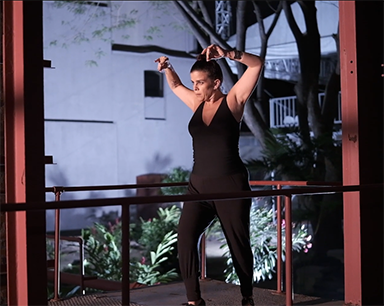
At the core of my work is a simple premise: the body is both archive and instrument. It carries personal, cultural, and spiritual histories that, through movement, become active, negotiated, and transformed. For this reason, my work begins with listening to the body, to the space it inhabits, and to the histories that move through both. I approach choreography as a ritual practice and a form of inquiry, treating movement as a way of knowing.
My practice unfolds at the intersection of ritual, improvisation, and research. Drawing from flamenco lineages, Afro-Cuban movement traditions, somatic practices, and contemporary choreographic inquiry, I explore how the body navigates multiple systems of knowledge at once; an approach shaped by my upbringing in Miami, where cultural crossings are lived daily.
In the studio, I work with “incubators,” structures that place dancers within specific conditions. Through deep listening—to self, others, and environment—movement emerges rather than being imposed. Spontaneity becomes a cultivated response.
I am interested in how choreography reveals relationships between bodies and environments. By tuning into the histories embedded in place, movement becomes a way of reading and responding.
Ultimately, my work cultivates awareness of the forces shaping our gestures, the histories we carry, and the possibilities that emerge through attentive relation. |
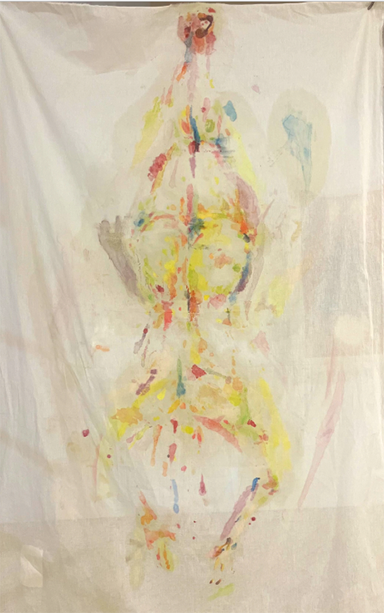
Morgan Brandwayn, Brooklyn , New York
My practice is based in oil painting, embroidery, sewing and latex body molds, to explore the obsession with flesh that came from my ceaseless awareness of my body. This awareness did not come from vanity, (though vanity certainly has played a part) but the knowledge that I was being perceived - not as a person, but as an object for consumption, by others. I wanted a way to take back control. I realized I enjoyed working with soft materials in ways that made them resemble human parts. In my desire to generate discomfort in the viewer I turned to liquid latex and body molds. I wanted to imitate peeled off layers of skin, to mutilate the body. The idea of clothing as ritual envelopment reminded me of the ritual envelopment of mummies of the Paracas Necropolis culture. They are enveloped in fabric in a ritual of remembrance of who they were in life so they would continue to be so in the afterlife. I began to see my practice not just as a mode of catharsis over lack of control, but also as a ritual of memory, in line with not just the Paracas tradition, but my own religious background. |
|

Ashley MacLure, Northborough, MA
Ashley MacLure is a mixed media artist working in drawing, collage, and assemblage in the Worcester County area. A graduate of the Rhode Island School of Design (BFA, 2009), she began her career as a professional illustrator before transitioning to teaching in 2013. In 2023, she earned an M.Ed. in Visual Arts from Framingham State University, uniting her passions for art and education.
Her work is expressive and conceptually rich, often engaging with difficult and uncomfortable topics. She believes deeply in the power of stories, the necessity of vulnerability, and the ability of artists to change minds and hearts. Themes of mental health, trauma, and motherhood are central to her practice, and her work has been featured in both national and international publications.
Ashley embraces life as a teacher, mother, artist, friend, and partner, continually seeking to empower others to find their voices and share their own stories. |
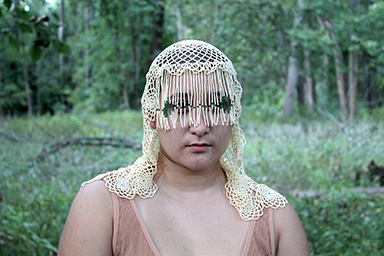
Sophia Karina English, Chicago
I am a multidisciplinary artist and craftsperson inspired by the lack of sociopolitical histories available to those with roots in heavily colonized parts of the world. My work finds itself inside a long history of beaded objects used as storytelling mechanisms and history keeping devices throughout Latin America. I use sculptural reinterpretations of familiar domestic objects along with beaded text to express feelings of loss, questioning, and a need for community. Writing about my own family dynamics and personal relationships, I invoke a universal understanding between myself and my audience. Through the hyper-intimate we find common ground. I often reference how my own familial history in Mexico and Nicaragua has been lost to violence, the poor record keeping of various governments, and secrets kept by women who needed to protect their families. In beading statements, questions, and problems, I am contributing to my family's written record and reaching towards the viewer for understanding. I am documenting my history as it happens.
|
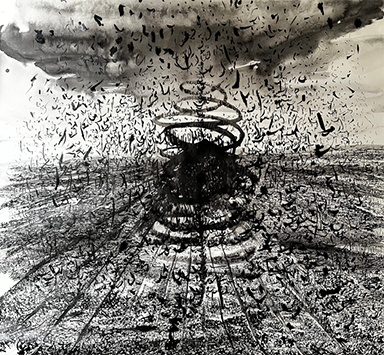
Bedia Ekiz, Turkey
Bedia Ekiz was born in the rich ecological and biological landscape of Çukurova, characterized by its volcanic cones and leached soils. She establishes a deep connection with her personal roots shaped by the mystical historical texture of this region—ancient Anatolia, mythologies, and a nomadic-pastoral lifestyle. The region’s archaeological mounds, ancient stories, bird sanctuaries, and ecological richness form the foundation of her profound explorations into human nature and existential traces.
Drawing from her personal witness and the expression of primal pain, Ekiz approaches urban habitats and the rewilding of the “three hills” through a philosophical, psychoanalytic, sociological, ecological, and spiritual perspective. Her artistic practice is centered on examining the existential relationships of human beings and the notion of psychogeography. She documents these experiences through performance videos, sound collages, interactive objects, sketches, and scents. In her studio, she immerses herself in these sources, engaging deeply with their technical and research-based dimensions. Alongside primitive materials such as paper, ink, and charcoal, she adopts a multidisciplinary language that
allows her research to resonate with intuitive human perception.
Raised in a nomadic (Yörük) and agricultural lifestyle, Ekiz aims to raise awareness through her art around themes such as ecology, biology, psychoanalysis, psychogeography, and Anatolian narratives. She continues her work in her studio in Kadıköy, Istanbul, and in the open-air setting of her home in Üçtepe, Çukurova, where she also documents her personal
witnessing. |
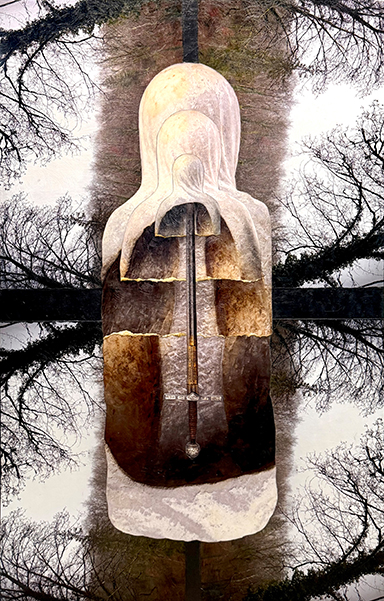
Robin Rivers, Vancouver, B.C., Canada
I work across photography, collage, and text to recover the lives of women the historical record left out, overlooked, or misremembered. My process treats this recovery of the lost not as reconstruction but as an act of attention—an attempt to give form to women whose stories survive only in fragments, margins, and silences. That attention takes different shapes depending on what an inquiry calls for. In my Skein series, three cabinet cards revealed three generations of a single family. Each woman, photographed at the same studio wearing the same mourning brooch, held that anonymity and turned it into a question: what is the vocabulary for how a woman was meant to be seen and remembered.
Sometimes it begins closer in — with my own camera, capturing images and transforming them through collage. What unites these approaches is a series of questions: what forces have controlled what we carry forward and shaped what we perceive as cultural memory of the dead? What is lost deliberately and what disappears more quietly, through centuries of social conditioning about whose life matters and what can be discarded? I make work that examines both kinds of loss: the archive's silences and the inherited assumptions about what is worth recovering in the first place. |

jessi t walsh
from rupture to garden.
|

Deanna Mance, Pittsburgh, Pennsylvania
Deanna Mance is a visual artist whose work references themes of transmutation, death and rebirth, personal and ancestral history, and spiritual and ritual practices in everyday life. Through freehand and spontaneous mark-making, she allows her work to develop without the restrictions of selfawareness or premeditation. This practice embraces the unpredictable qualities and uncertain outcomes of the work, while drawing inspiration from the constraints of limited materials.
Mance expanded her work into arts education and administration at The Carnegie Museum of Art, Pittsburgh Center for the Arts, Sunburst School of Music and the Hyde Park Art Center. These roles strengthened her commitment to community engagement, lifelong learning, and ensuring the arts remain inclusive to all.
In 2012, she integrated her passion for the arts with end-of-life care, working with individuals living with Alzheimer’s and dementia as a Life Enrichment Coordinator. She later became a Pittsburgh Death Café facilitator, certified death doula, and founding member of Pittsburgh Community Deathcare.
Today, Mance serves as Assistant Manager of Penn Forest Natural Burial Park, where she provides guided tours, supports families through end-of-life planning, directs burials, contributes to land stewardship and community education.
Her current work-in-progress brings these experiences together. She’s harvesting wild clay from the
land at Penn Forest to create hand-built ceramic pieces gifted to the families she serves in honor of
their loved ones. Each piece offers a tangible connection to the land where they rest and serves as
a token of appreciation to those who have entrusted Penn Forest with their care.
Born in Cleveland, Ohio, Mance currently lives in Pittsburgh, Pennsylvania. |

Maradee Slater, Seattle, WA
I make performance at thresholds: body and object, ritual and theatre, myth and document, terror and tenderness, presence and absence. I am drawn to the instant a material becomes a ghost, a body becomes an archive, or a place becomes a tool for facing what we are trained to avoid.
Death entered my practice through Butoh, long before loss made it personal. Butoh taught me to attend to decay, transformation, slowness, grotesquerie, and the body as something porous, impermanent, and haunted. Then death kept working with me. After my father died, I carried his ashes through New York until part of him became tattoo ink in the words “oh world that’s you!” Years later, Timothy White Eagle deepened my understanding of ritual as practice: humor, objects, care, and sacredness accompanying a person toward death. I witnessed his final weeks alongside his community. Days later, my childhood best friend died. That was yesterday [9.11.2026]
I want to study death as material transformation: what remains, what changes form, what becomes sacred, and how the living care for bodies, objects, landscapes, stories, and one another. I want to make work that stands beside the unbearable without explaining it away, and exposes the machinery without destroying the magic. |
Christina Lett, Midland, GA
My work explores grief as a response to change: the evidence that something mattered, something shifted, and we were changed by it.
I am interested in thresholds - the spaces between what was and what comes next. Death is one of those thresholds, but it is not the only one. Relationships end and begin. Bodies change. Identities expand. Possibilities disappear. Beliefs collapse. Love alters us. Even joy can ask us to release a version of ourselves we no longer need.
Through painting, mixed media, and story, I make work from these moments of transition. I am drawn to images that hold both tenderness and unease: animals at the edge of something unknown, bodies transforming, objects carrying memory, beauty growing alongside loss. My work does not try to resolve grief or explain it away. I want to give it form - to make the invisible weight of change tangible enough to sit beside.
My practice is rooted in the belief that grief is not only about death. It is part of being alive in a world where nothing stays exactly as it was. I make work from that impermanence: noticing what changes us, metabolizing what remains, and offering something back. |
Vanessa Iafolla, Dartmouth, NS
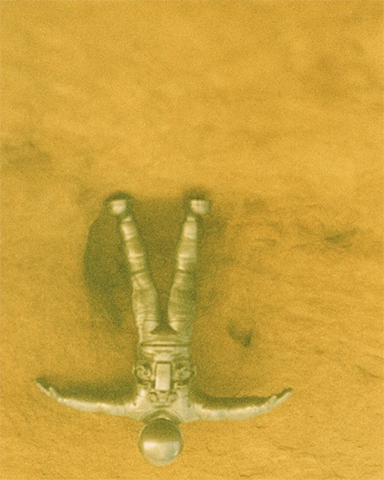
My artistic practice explores themes of grief, death, and life post-mortem. I am trained in ethnographic research and rely upon this training in my artistic practice, which explores cultural approaches to death and memorialization, including posthumous collaboration. This aspect of my practice developed in response to the death of my younger brother, Tristan, who died in 2024, in a car accident in Utah while on vacation. I am interested in the way death and land interact through legal structures, cultural practice, and individual experiences of death and grief. I have used plants grown by my brother, who was a landscaper with particular interests in native flora and fauna, to process photographs of the Utah landscape and make anthotypes of him. I have created a series of soil chromatograms using dirt taken from the site of the car accident, his last home, and his gravesite. I am currently working on a series of salt print photographs made using salt taken from Great Salt Lake; future plans for my art practice include making environmentally-friendly gum bichromate photographs using alternatives to potassium dichromate, and to use pigments I have made from soil harvested from places identified on his road trip in Utah. |
Eileen Wiediger, Leesburg, VA
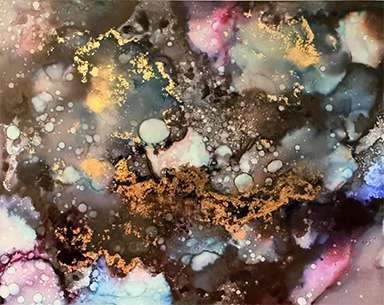
My artistic practice explores perception as a living, relational process. Working primarily with alcohol ink, mixed media, collage, and symbolic forms, I am interested in the space where intention and emergence meet; where material behavior and intuition interact in ways that resist complete control.
Rather than beginning with fixed narratives or predetermined outcomes, I approach art-making as a form of inquiry. The work often unfolds through layering, interruption, fluidity, fragmentation, and response. In this process, images and forms are not imposed so much as discovered through sustained attention and dialogue with the materials themselves.
I am most intrigued by transition: edges, thresholds, ambiguity, dissolution, and becoming. Much of my work investigates what can emerge when perception slows enough to encounter experience before it is immediately categorized or explained. Phenomenology, symbolic inquiry, contemplative practice, and process-oriented philosophies inform my approach, along with ongoing explorations of creativity as a mode of perception rather than solely one of self-expression. With my practice, I hope to create experiences that invite viewers into spaces where meaning remains active, participatory, and unfinished.
|
Emma Jolly, Kerhonkson, NY
My name is Emma Jolly. I am a student in the New Media and Fabrications program at Purchase College.
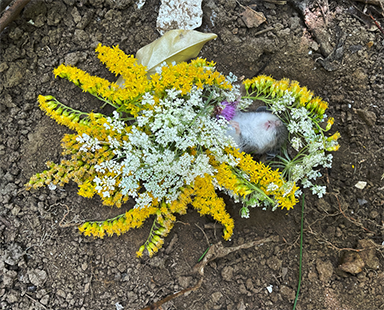
I try to practice every medium of art and creation I can get my sticky fingers on; from making music, to writing, coding, sculpting, drawing, baking, arranging, performing, sewing, filming videos, and snapping pictures -- my practice knows no bounds!
I've always had a riveting passion to learn, especially in the fields of philosophy, anthropology, thanatology, technology, and botany; I dream of using this passion to adjust the lens we perceive, practice, and experience death.
In my spare time I am often working on personal projects (music videos, songs, and performances), reading, writing, or playing dress up. I pride myself in being a proficient and practiced tarot reader, outdoorsman, and florist.
|
| |
Aullar Mateo, Brooklyn, NY
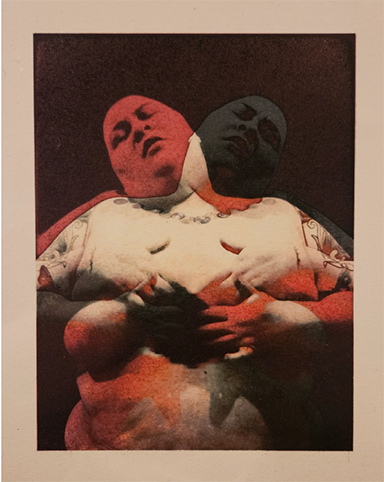
Grief is a deeply personal experience, but it shares many similarities that allow us to empathize with one another. It involves loss, pain, and the inexplicable abstraction of the body and mind that occurs when we mourn. These avenues of thought coalesce in a creative space that I am currently exploring. Through paintings and glass sculptures, I examine the physicality of death and decay, as well as the emotionality of what happens to the dying and those who remain. Through my work, I traverse the transitional aspects of life and death, seeking to acclimate myself to a new life and a new self after loss. Much of my art was about recording life, maintaining the shroud of immortality. Now I’ve moved out of that space of falsehood to a space that presents mortality, albeit abstract. I have come to find that I desire questions to guide me and my work, not to find unattainable answers, but to lead me to those who are willing to sit in these questions and create space for grief. |
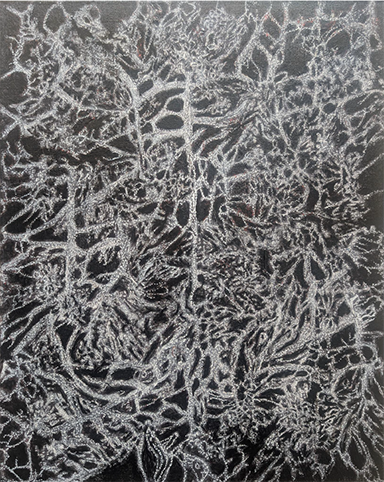
Andrea Travaglia, Port Noarlunga South, Adelaide, South Australia
I am an emerging Adelaide-based mixed-media artist with a background in archaeology and natural/cultural heritage. I am currently exploring how value is assigned to places, objects and stories. What is collected, preserved and remembered, and what is overlooked or allowed to disappear?
Drawing on archaeological methods of observation, interpretation, documentation and stewardship, I work across painting, drawing, collage, text, photography and found materials. I am interested in the relationship between official histories and lived experience, working with fragments that carry personal and shared meaning: a surface, object, photograph, sound, route or ordinary detail.
Through site-responsive research, close observation and material experimentation, I am interested in exploring history, time, cultural identity, memory, care and environmental change. I am increasingly drawn to questions of mortality, mourning, memorialisation and ecological loss, considering how places and materials can hold traces of absence as well as presence. |
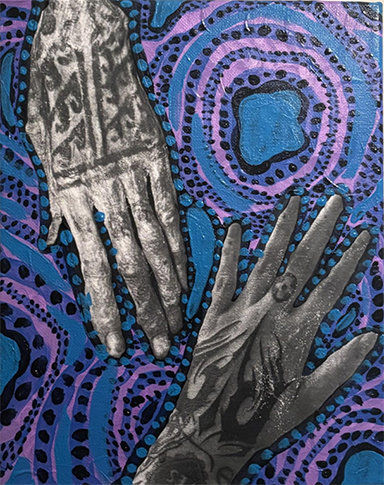
Allie Dennis Glancey, Meredith, New Hampshire
My name is Allie Dennis Glancey and I am a New Hampshire based multidisciplinary artist with a primary focus in painting. Much of my work features a combination of abstract shapes and layering of patterns, and frequently implements the use of collage to convey an overall message or feeling within each piece I create. Dot work is another repeating motif I use in my work frequently as the process of painting or drawing dots has become a meditative experience that calms my mind of anxiety and depression. I create art because if I don’t then my existence will just be working at a grocery store to pay the bills and provide for my family, but choosing to be an artist has helped me to find a purpose to an otherwise remedial life. |
Rebecca Hanssens-Reed, St. Louis, Missouri
As a writer and translator my practice has tended to revolve around the living: collaborating with a Puerto Rican writer to “bring to life” her work in English, or detailing a late translator’s career to construct a compelling biography for working translators to read. Yet in the last few years I have felt death come closer, and am increasingly interested in death work and how one might build a life around it. In 2022 I began volunteering at a senior dog sanctuary that houses abandoned and terminally ill elder canines. One day, I was asked to hold a dog with advanced kidney disease; we sat in the sun and I was stunned by how palpably I could feel his readiness to die. Then my own dog, at sixteen, developed a terminal illness, and I had to make the terrible decision about when to let him go; the professionals who stepped in to assist in this process blew me away with their wisdom and grace. Their openness to what is often an unfathomable, painful, and lonely event, inspired me to then begin volunteering as a hospice companion. I believe that you can learn about a society through the way it approaches death and treatment of the dying. In my writing, I seek to reflect a world whose systems are often alienating, violent, and exploitative by design, and yet to also reveal its beauty by honoring the process of death. In my life, I hope to advocate for regarding death and the dying with greater care. My writing in the last few years has reflected this growing interest: recent short stories deal in various ways with the effects of war and capitalism. |

Araks Sargsyan, Los Angeles, CA
Art has always been an essential part of my life , I know no other way of existing and functioning. It is my means of translating the life experienced by me , bringing feelings and inner tides to this realm through detailed pen and ink illustrations, sculpture and digital art.
My style transforms as I undergo my own metamorphosis. While integrating the change I always keep a past part of me there, to honor the road, to honor my past selves.
I depict dream state surreal images or 3d objects that invite the viewer to be still and observe- as in observing lies the act of being in the moment, fully embraced by my creation.
There is no single line to put down as a statement. For me existence and creativity are the main statements, the rest are thoughts and processes. |

Paulina Larocca, Sydney, Australia
I am a transdisciplinary artist–researcher working with grief, more-than-human entanglement, and the long afterlives of systems in collapse. My practice moves between watercolour, ink, installation and participatory workshops. I treat materials as co-researchers and residues as evidence of what bodies and institutions cannot resolve.
Recent projects include Fractals of Nature, a multisensory installation at the National Art School, Sydney and Soft Remains, an ongoing body of work that treats endings as compost rather than closure. Alongside this, I run Metabolising Through Making (MTM) labs in health and education contexts, where participants work with movement and simple materials to process end-of-life decisions, institutional change and research violence.
|

Adam Romano, Ooltewah, TN
I create dark, surrealist paintings crafted for curious seekers, visionary tastemakers, and unique thinkers.
Designed to command space within high-net-worth private collections, boutique hotels, avantgarde dark art galleries, and premier contemporary museums, each piece evokes contemplation towards morbid intrigue and empathy.
The work serves as a powerful call-to-action—connecting viewers to the intersection of grief, societal trauma, and mortality through haunted figures and textured space. |
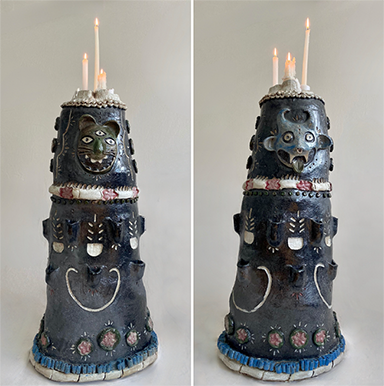
Bella Marinos, LA, California
Through my sculptures and hybrid altars, I express a longing to connect: to my community and to strangers, to my family and to my own body. Both a physical manifestation of this desire and a catalyst for communal storytelling, my work examines intergenerational trauma, death and grief, gender identity conflicts, and the ways our sociopolitical systems perpetuate suffering. As of late, I have been especially fascinated by connection, obsession, and secret-keeping present in ephemeral objects and oral histories that have been historically disregarded.
My many ceramic characters (tenderly referred to as my “guys”) are inspired by a type of Mexican folk art object, alebrijes—mythical hybrid animals. These spirits protect the living and help those who have passed move between the physical and spiritual realms. My “guys” are always genderless, and never malicious. Some are portraits of myself, friends, and family, while others are the embodiments of fleeting, emotionally-charged, often traumatic experiences.
My hybrid altars utilize found objects and oddities like locks of my estranged mother’s hair, taxidermied bugs, blood, ink, rosaries, rotting wood, latex, milagros, and beeswax candles. These combinations juxtapose elements of Catholicism, Greek Orthodoxy, and Brujeria. Repetitive elements nod to the ongoingness of religious practice, and to a repetitive fervor that borders on the obsessive.
Together, my subversive portraits and altars exist within a hazy spiritual tomb that offers a place where we can collectively mourn, wish, and remember outside the bounds of acceptable gender performance, religious guilt, and cultural expectations.
|
Alumni
We have had the absolute pleasure of learning with hundreds of amazing artists over the years. You can find them here. Click on a topic to see all of the Biophilium and Ayatana artists who have been research fellows and artists in residence with us since 2014.
|
  
  
|